Why Ecological Sanitation?

a. It utilizes urine-diverting, dehydration toilets (ecosan) as a means to improve management of human waste in waterless communities such as upland areas and use this in order to improve nutrition among poor populations. Due to climate change, some area in the Philippines have less and less water and flush-pour toilets are no longer an effective way to manage human waste so people do open defecation thereby spreading diseases and helminths. The Philippines is number 3 in Asia with an epidemic in helminths infestation especially among children;

b. Ecosan toilets is not new and so many are advocating its use, but the problem is that these proponents are focused on using materials purchased from the cities/towns (eg. cement, rebars)  and are thus expensive and inaccessible by the poor who needs it most. Our approach is to custom-design ecosan toilets using locally-available materials and there is no need to purchase from the town anymore;

c.  Most ecosan proponents have not considered how to re-use human waste in agriculture and small-scale gardening for food, thus mountains of human waste are left unprocessed and poses a danger to the community and environment. In our case, we have devised a system of organic fertilizer production using local micro-organisms (eg. lactic acid bacteria) to decompose waste and render it safe for re-use as fertilizer and producing what we call “terra-preta biochar sanitation (tpb-s) fertilizer”.   Terra Preta is the anthropogenic black soil that was produced by ancient cultures through the conversion of bio-waste and fecal matter into long-term fertile soils and the amazing thing is that terra-preta soils do not need fertilizer anymore. Our early experiments show a lot of promise in the production of terra preta fertilizer and we will be producing terra-preta mix taking into consideration carbon-nitrogen ratio and organic matter content.

d. . While others are implementing dry toilet projects for the poor as dole-outs which the poor sometimes resent, we are doing ours on a micro-financing scheme and integrating it into the larger micro-finance initiative and local livelihood development of poor households. Thus when a beneficiary take a loan to support livelihood projects, he can also take a loan for a dry toilet.


Mindanao Ecolife Cafe

The Mindanao Ecolife Café is organized with the main aim of bringing the power of the web to positively affect the lives of poor and marginalized youth.  The youth are very vulnerable to climate change and are mired in poverty and joblessness and the web has a wealth of solutions for job creation and linking with experts and organizations that can pump-prime their local livelihood initiatives. We will start mainly with youths who have the basic skills and bent to surf the web. Their learning, on a multiplier effect, can then be used to start small, doable local livelihood projects that will benefit themselves and their families. 

Internet Café’s abound in schools, urban and rural centers, but these are mainly used for simple emails and gaming. The power of internet café’s is not harnessed to the fullest, when in fact advanced knowledge is there at the tap of the keyboard. No one has thought about this and this is an innovative concept. It has the capacity to equip the poor to search for knowledge in order to adapt to launch new jobs using local resources. Aside from generating knowledge from the web, the user can also interact with our best and brightest embarking on their Diaspora in search of a better future in foreign lands. There are so many organizations, network, individuals out there willing to help be it in social forestry, promotion of local livelihoods, green technology, coastal resource management, ecological sanitation, and so on, the list is endless.  Then this will become a South-North dialogue. Tackling climate change should be the concern of everybody because with the ill-impacts of climate change, we sink together with our only planet.  The Mindanao Ecolife Café provides this avenue for mutual dialogue and mutual help. 

Sustainable Ecosystem Restoration Pilot Project in Mindanao

The project is aimed at sustainable ecosystem restoration by implementing the following activities, a. conservation of most important fruit and timber tree species, b. establishing a seedling nursery, c. promoting the growing of multiple crops in order to improve biodiversity and increase food security, d. food processing of surplus crops, and, e. training and mobilizing youth to manage, lead and implement the activities. We aim to restore 120 hectares of denuded forestland and enlist 175 youth-leaders in the process.

This project is in partnership with LUSH COSMETICS – CANADA

White Beauty Flies to Freedom

CAGAYAN DE ORO CITY, Misamis Oriental, April 27 (PIA) — A tropical white-tailed bird which was accidentally caught at sea has just been released to its natural habitat and is now free.

The bird, for a short time, was kept at the Regional Wildlife Rescue Center, after it was turned-over, last April 8, to the Protected Areas, Wildlife and Coastal Zone Management Services (PAWCZMS) of the Dept. of Environment and Natural Resources (DENR), region 10.

The migratory bird had a most interesting fate, when by chance, it came into a collision course with a cargo ship bound for Cagayan de Oro City (CDOC) from Metro Manila, Dr. Belen O. Daba, Officer-in-Charge, Regional Technical Director for DENR’s PAWCZMS, in the region, said.

Called “white beauty,” due to its extra long tail which actually doubles its size in length, it’s a beauty to see when flying, the bird was discovered by porters in the CDOC’s Macabalan Wharf.

It was believed to have accidentally swooped into the ship’s cargo bay as the ship passed along a portion of i

its route exposed to the China Sea.

The White-tailed Tropicbird (Phaeton lepturus) freely flies across three oceans, namely the Atlantic, Indian and the Pacific and scours the open ocean in search for food, and can even float to rest, tropicbirds also seldom fly near the shore.

Meanwhile, Daba said aside from its many advocacies and responsibilities, it is also tasked by the Philippine government to look after all wildlife, be it from land, sea and air.

Thus, Republic Act 9147 or the Wildlife Resources Conservation and Protection Act, prohibits the collection and hunting of threatened wildlife.

Along, this line, PAWCZMS is in charge in rescuing and handling animals who has lost its way, after being caught in mishaps or perhaps illegally kept, Daba added (DENR/PIA-10)

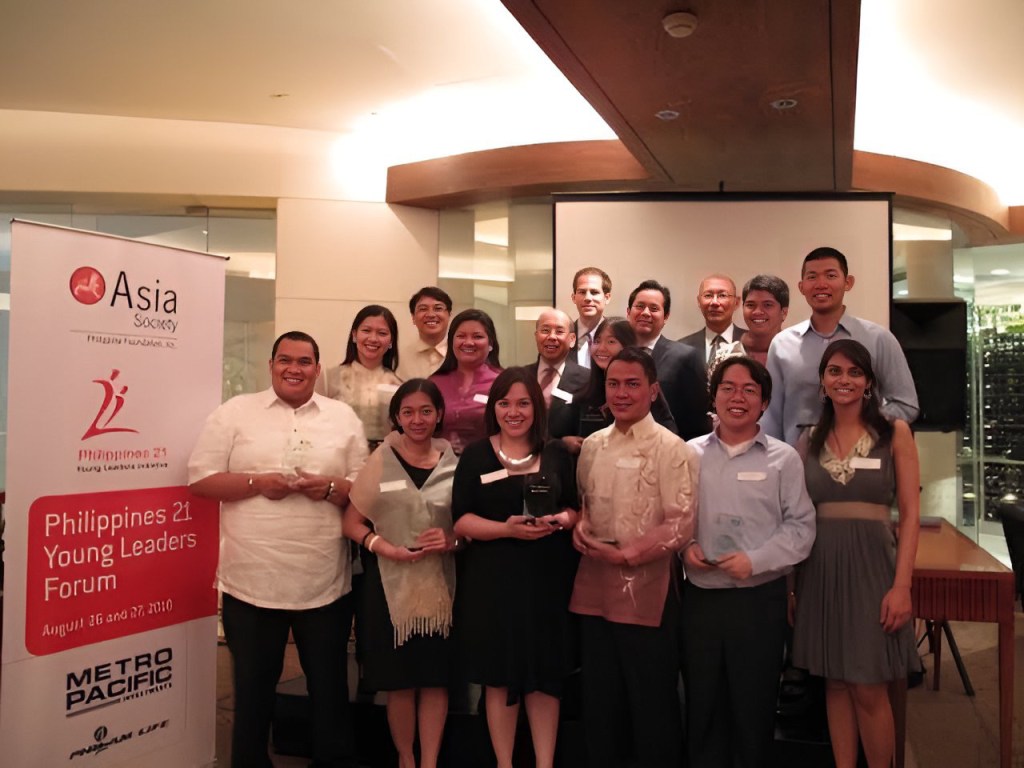
Asia Society Announces Philippine Class of 2010

Young leaders from business, civil society and government are among the changemakers selected for the Philippines 21 Class of 2010. A flagship program of Asia Society-Philippines, the Philippines 21 Young Leaders Initiative aims to develop a nationwide, multi-sectoral network of changemakers to meet, educate and inspire each other; collaborate and share ideas on public service and other meaningful initiatives, and build relationships of trust and understanding.

The new Fellows are: Regina Irene Gaza (Business-Fair Trade), Therese Clarence Fernandez (Business-Social Enterprise), Maria Concepcion Hernandez (Government), Bryan Albert Lim (Health), John Piermont Montilla (Non-profit/Civil Society), Jed Christian Sayre (Government), Jason Roy Sibug (Non-profit/Civil Society), Cecilia Clare Reyes (Government), Erika Tatad (Business-Social Enterprise), and Mark Anthony Yu (Business).

The Fellows convened in a 2-day Forum on August 26-27 at the AIM Conference Center. Organized with the support of Metro Pacific Investments Corporation and Philamlife Insurance, the forum provides a venue for discussing issues of national and regional importance, with the ultimate goal of developing projects that address these concerns. Among the speakers invited to share their insight with the Fellows were 2010 Ramon Magsaysay awardee Mayor Tadatoshi Akiba of Hiroshima, and Asia Society Philippines trustee Dr. Carolina Hernandez, chair of the Institute of Strategic and Development Studies.

Philippines 21 Fellows serve as the country’s official delegation to the annual Asia 21 Young Leaders Summit, a regional leadership conference organized annually by Asia Society New York. This year’s Summit is slated for December in Jakarta, Indonesia.